
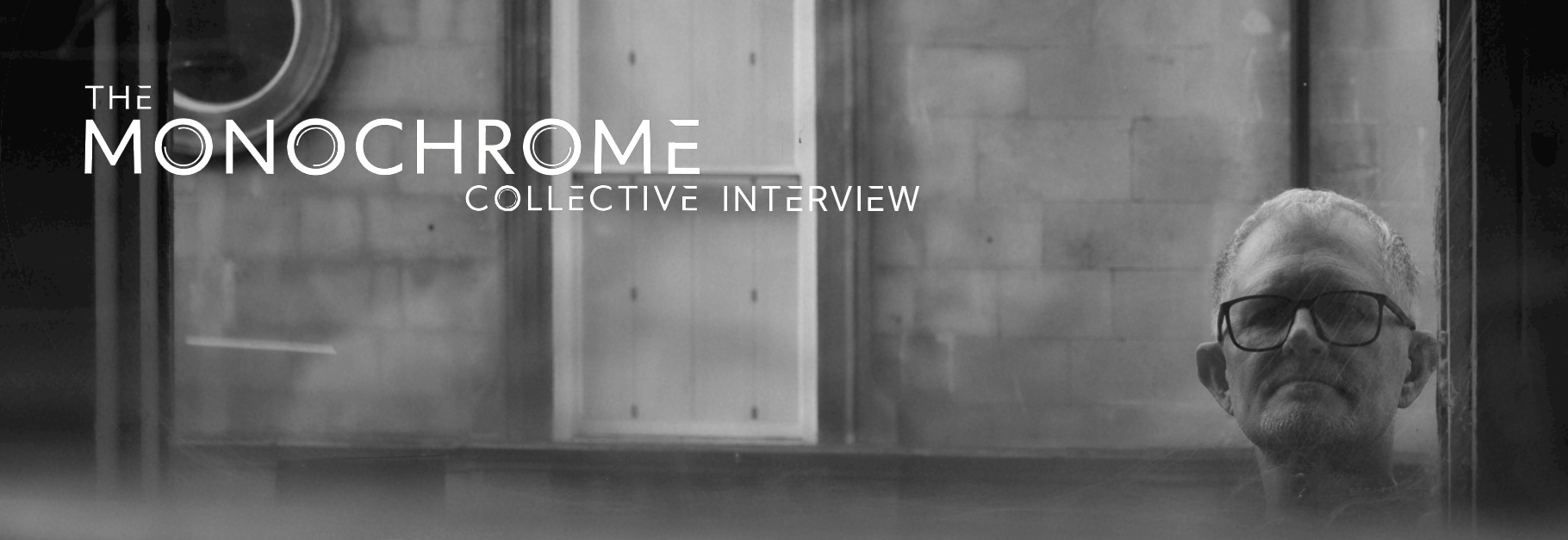
THE PHOTOGRAPHERS BEHIND THE MONOCHROME IMAGES.
There is no shortage of black and white photography on the internet. What is harder to find is the person behind it. The way they think. The reason they shoot the way they shoot. The influences that shaped them and the questions they are still trying to answer.
Photographer Spotlights goes behind the lens. Each piece is a full interview with a black and white photographer from somewhere in the world. We ask about their process, their gear, their influences and their work. A conversation with someone who has something worth saying about monochrome photography.
THE MONOCHROME COLLECTIVE'S INTERVIEW WITH LEIGHTON PHILLIPS
A photograph of a single drooping leaf sent him looking for neglected houseplants everywhere he goes.
Leighton Phillips never had a single defining moment that pulled him into photography. It arrived gradually, starting with his father's Pentax MX and deepening slowly as he began paying closer attention not just to what he was photographing but to what was worth isolating from everything else in the frame.
He describes much of his work as Urban Still Life, drawn to the mundane and the overlooked, an object, a surface, a shadow, a small detail easy to walk past without noticing. His black and white style developed the same way, not as a deliberate stylistic choice but as a gradual realisation that colour often distracted from what he was actually responding to, light, tone, and the relationship between shadow and presence.
He shoots almost entirely spontaneously, favouring a heavier 90mm macro lens over a lighter one specifically because of how it lets him isolate and compress a scene, and he edits with real restraint, treating an image that needs too much post processing as a sign it was not fully there to begin with.
We asked him about a single drooping houseplant that opened up an entire new direction in his work, and why he decided to stop chasing the next best camera and other people's opinions of his photographs.
THERE'S ALWAYS A MOMENT THAT PULLS SOMEONE INTO PHOTOGRAPHY FOR GOOD. WHAT WAS YOURS?
I don't think there was one particular moment that pulled me into photography for good. It was more of a gradual progression. When I was younger, I used point-and-shoot cameras, and later I had access to my father's Pentax MX. It was simply a more advanced tool than I was used to, and it gave me more control over what I wanted to achieve. At the time, I didn't attach any particular significance to the camera itself. It was just another step in learning how to use one.
Photography became more interesting to me as I started paying more attention to what I was actually photographing. Gradually, it became less about recording what was in front of me and more about deciding what was worth isolating from everything else. I think that shift, rather than any particular camera or photograph, was probably the point at which photography became something I wanted to pursue seriously.
WHAT SUBJECTS ARE THE FOCUS OF YOUR WORK AND WHY?
I tend to think of much of my work as Urban Still Life. I'm interested in the mundane, the ignored and the unnoticed things that exist around us every day. That might be an object, a building, an arrangement of things, a surface, a shadow or some small detail within a much larger environment. I'm not necessarily looking for something conventionally beautiful or obviously interesting. In fact, the lack of obvious significance can be part of the appeal. I like capturing something that has become visually familiar and giving it enough attention to reveal something else within it.
Urban Still Life gives me a way of working with those subjects without having to define them too narrowly. The object or setting is important, but so are the relationships between shape, light, texture and space.
YOUR BLACK AND WHITE WORK HAS A PARTICULAR FEELING TO IT. HOW DID YOU ARRIVE AT THAT? WAS IT DELIBERATE OR DID IT EMERGE OVER TIME?
It definitely emerged over time. I didn't start out thinking that I wanted to develop a particular black and white style. I gradually found that colour could sometimes be a distraction from the qualities I was actually responding to. For me, monochrome is primarily about light and tone, and how those can create separation or isolation within an image. Without colour influencing the way a subject is read, I'm able to concentrate more on the relationship between light and shadow, the tonal separation between elements and the overall feeling or emotion within the frame.
I like the way that can alter our perception of something quite familiar. A subject can become less literal and more about its presence within the photograph, how it sits within the light, what is left in shadow and what the tonal structure conveys emotionally. I think that is where the particular feeling in my black and white work has developed. It isn't simply about removing colour, it's about using light and tone to create the atmosphere I experienced when I made the photograph.
During the Covid-19 lockdown I was chosen to be a beta tester for a number of Lensbaby lenses, which gave me an opportunity to experiment with how optical characteristics could influence an image at the point of capture. That was an interesting period of experimentation, but my preference for monochrome developed independently through the direction of my work.
TELL US THE STORY BEHIND ONE OF YOUR FAVOURITE PHOTOGRAPHS.
That's a bit like asking me which is my favourite child. I find it almost impossible to pick one photograph and say, "That's the one." The photographs I tend to value most are usually the ones that take me by surprise. They're often not what I was looking for when I went out, and sometimes they're not even what I would have expected to photograph. Something catches my attention, I respond to it, and afterwards I realise that the image fits naturally within the direction of my work. Occasionally it can even suggest another direction entirely.
Having said that, there is one particular image that isn't necessarily a standout favourite photograph, but it has started a journey into a series that is proving to be a slow burn, but one that really intrigues me. It's a photograph of a potted plant with just one leaf left, drooping over the side of the pot and looking very sorry for itself. I had noticed it in passing, through a window on a back street in Bristol. There was something about it that made me stop and take a second look.
Since making that photograph, whenever I'm out with my camera, I seem to notice them everywhere. They're often forgotten, once-prized possessions of a home, office or public space. They were presumably bought because they brought pleasure, added something to a room, or perhaps offered a sense of calm, but have gradually become neglected and almost invisible. There's something about that transition that really interests me. They seem to fit naturally within my work, and this is one of those occasions where a photograph has taken me somewhere I wasn't expecting to go. I don't know where the series will eventually lead, or whether it will become a defined body of work, but for now I'm enjoying discovering it. That's probably what makes those photographs special to me. There wasn't a predetermined image I was trying to capture. The photograph came from being receptive enough to recognise something when it presented itself.
WHAT IS ONE THING THAT YOU ARE WORKING TO IMPROVE IN YOUR PHOTOGRAPHY AND HOW ARE YOU GOING ABOUT IT?
Honestly, I'm still trying to see better, or perhaps, more importantly, to see differently from the norm. I'm interested in becoming better at recognising visual possibilities that aren't immediately apparent. I want to look at a subject more abstractly, or see relationships between shapes, textures, light and space that might otherwise be overlooked. It's easy to photograph what you expect to find. I'm more interested in developing the ability to move beyond that first reading of a scene and find something less obvious within it.
I'm doing that mainly by continuing to photograph, but also by spending more time looking at my own work critically. I'm interested in understanding why certain images hold my attention and others don't, particularly when the technically competent photograph isn't necessarily the more interesting one. For me, it's less about adding another technical skill and more about developing a more discerning eye.
HOW MUCH DO YOU PLAN VS. SHOOT SPONTANEOUSLY?
Probably about 90% spontaneous. My opportunities to shoot are usually stolen moments here and there rather than dedicated or planned periods of photography. I might have a location in mind, or find myself somewhere because the conditions look promising, but I rarely go out with a specific photograph in mind. When I do find something that interests me, I would rather have the time to soak in the location and understand what it is that has drawn my attention. That gives me a better chance of representing not just the subject, but the feeling or emotion it creates. I prefer to let the location and the subject dictate the photograph rather than trying to make the environment give me an image I had already imagined.
WHAT GEAR DO YOU TAKE WHEN YOU GO OUT TO SHOOT?
My current setup is a Sony A7IV with two lenses, the Sony G 40mm f/2.5 and the Sony 90mm f/2.8 Macro G OSS. The 40mm gives me the lightest setup, so at the moment it's easy to default to simply because it's convenient to carry. But the 90mm is actually my preferred lens, despite being considerably heavier. I really like the way the 90mm lets me isolate subjects and compress the relationship between elements within a scene. It's also incredibly sharp, which I enjoy even though I'm trying to give much of my work a softer, more filmic quality. I like having that degree of optical resolution available and deciding how I want the finished photograph to feel.
I've used quite a few cameras over the years, including a Leica Q2, a Hasselblad 500CM with the Zeiss Planar T* 80mm f/2.8, and a Canon 40D Mark II with various lenses. I've also used Kodak Box Brownie SIX-20s from my collection, as well as various Lensbaby lenses while beta testing them during the Covid-19 lockdown.
WHAT DOES YOUR EDITING PROCESS LOOK LIKE? WHAT TOOLS DO YOU USE AND HOW DO YOU APPROACH IT?
I use Adobe Lightroom Classic. I import my RAW files into Lightroom and use it for the majority of my editing, as well as cataloguing, organising and exporting the work. My editing is deliberately minimal. I'm not trying to transform the photograph into something that wasn't there. I'll make adjustments to exposure, contrast, highlights, shadows and the overall tonal balance, but the intention is to bring the image towards what I experienced when I made the photograph.
With black and white work, those adjustments are particularly important because the absence of colour places much more emphasis on the tonal structure of the image. I'll spend time getting the feeling I experienced when capturing the subject to come through appropriately in the finished photograph. The process is fairly restrained. If I find myself having to do too much to an image, that's usually a sign that the photograph wasn't quite there to begin with. Lightroom also acts as my archive, so there is a practical side to the process as well. Being able to find, revisit and compare work from different periods is an important part of my practice.
WHO ARE SOME PHOTOGRAPHERS OR ARTISTS THAT HAVE INFLUENCED YOUR STYLE AND WHY?
Saul Leiter is probably the biggest influence on me, particularly his early black and white work. I really admire the way he used light, tone and composition to create photographs that can feel both immediate and elusive. There is a restraint to his work that I find very appealing. Olga Karlovac is another photographer whose work really resonates with me. I like the instinctive quality of her photographs and the way she uses atmosphere, movement and abstraction without losing the sense of the scene.
Vivian Maier's work appeals to me for its observational quality. There is a sense of genuine curiosity in the way she photographed the world around her, and I find that very engaging. Robert Frank and Garry Winogrand are perhaps less obvious influences when you look at my work. I wouldn't necessarily expect someone to see a direct visual connection, but there is something in both of their work that resonates with me.
I think what I respond to across all of them is the individuality of their work. They each had a very strong sense of what interested them photographically, and that comes through without needing to be explained. That's something I find both inspiring and reassuring.
WHAT WOULD YOU TELL YOURSELF WHEN YOU STARTED IN PHOTOGRAPHY? THE THING NOBODY SAID TO YOU THAT WOULD HAVE CHANGED HOW YOU PHOTOGRAPHED?
I'd tell myself not to worry too much about what other people have to say about my work, unless they're photographers or peers whose judgement I genuinely respect, or unless I've specifically asked for their opinion. Social media makes that particularly difficult. I've been around social media since its early days and was even a Gallery Director on DeviantART for a period. At the time, it was one of the better online communities for photographers, being easy to use, with a wide reach, and a place where quite a few photographers who were active there went on to become well respected within their genres.
Over time I've learned that you have to be selective about what you allow to influence your judgement. The volume of opinion online can make it very easy to lose sight of your own standards. A throwaway comment from someone who has spent ten seconds looking at an image shouldn't carry the same weight as considered criticism from someone whose work and judgement you respect. At the same time, other photographers can be a valuable source of inspiration, so it's about being discerning rather than simply dismissing outside opinion.
I'd also tell myself not to get too caught up in the hype around equipment and photography advice. There is a huge amount of content telling photographers what camera they need, what lens they should buy or what technique they should be using. Much of that content is ultimately designed to generate clicks, affiliate revenue or sales. There's nothing wrong with learning from other people or enjoying new equipment, but since making the deliberate decision to stick with my current equipment and ignore the constant "next best thing" that social media influencers and manufacturers would have you believe you must have, I feel my work has become more refined.
Ultimately, I'd say, establish your own standards, be selective about whose opinions you value, take inspiration where it genuinely helps, and trust the direction your own work is taking.
Originally published by The Monochrome Collective